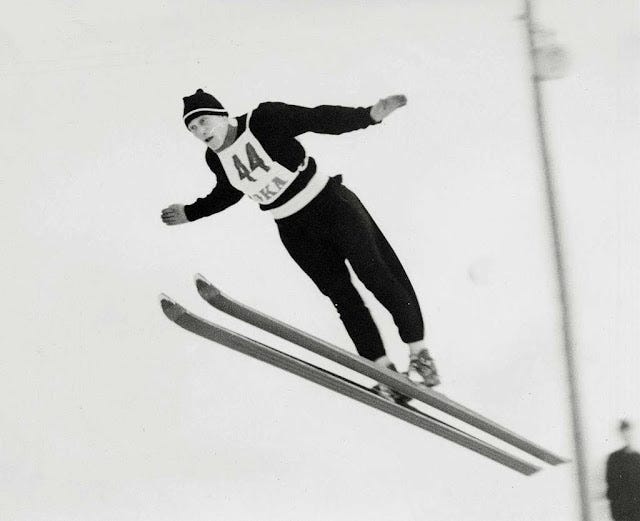
In a recent conversation we had, Ed Jollyboat used the analogy of an airport runway as a linear introductory section to a game, which opens up into blue sky freedom. I want to run with that, but I’m moving over to a ski jump analogy instead.
In short:
Climb: Make it easy to get the book to the table and have other players want to play. Descent: Begin with limitations and linearity to give the game momentum. Launch: Now get the players making big choices. Flight: Support the play that comes from player freedom. Landing: Have a finishing point in mind, even if you don’t stick to it.
Now the longer version.
The Climb
Sure, there are no-prep games, but really I think any activity that involves simultaneously getting a bunch of friends around the same table requires at least a form of prep. Forget drawing maps and practising NPC voices, the real climb is done in the real world.
I’ve heard much anger at the idea of putting marketing copy inside your gamebook but... hear me out... in some groups... the GM does need to market the game to players in order to get that game to the table.
Worse still, as a GM with a bunch of books on my shelf, those books aren’t done marketing themselves to me yet. They need to sell their dream to me even as I hold them in my hands. Not vying for my attention, but working to convince me that I can and will run this game, leaving me passionate enough to draw a group of players in and make the dream a reality.
The Descent
That’s the hard part out of the way. It’s all downhill from here. Of course, you can’t change direction, but it’s just for a little while. This is the part where you set the players quickly off in a certain direction and stack up the momentum. Traveller’s lifepath and ship mortgage are classic examples. Electric Bastionland’s Debt and Mythic Bastionland’s Oath are my attempts at this.
The Launch
The point of transition between that linear descent and the open skies of flight. At its most basic level I plan my RPG sessions to have an important decision thrown at the players almost immediately. A dungeon with a front door and a sneaky tunnel round back. A hex map with a starting point and vague directions to your first hook. The splash of cold water that wakes up the decision-making brain.
The Flight
This is the “hey this game runs itself” dream. With the players fully engaged, invested, directing the play, all you’ve got to do is enjoy the view and watch out for geese. The important thing here is that the players enjoy this freedom that we’ve been building up to, without feeling overwhelmed as they might be if we just shot them out of a cannon without warning. The GM also needs support, typically from library content in the book, or tools to help with improvisation.
The Landing
I imagine Ski Jumping 101 has a pretty early class on “how to land”, but for a long time I didn’t really think about how my sessions or campaigns might finish. I’m especially interested in the latter, now, as you’ll see in the City Quest of Mythic Bastionland, or the equally appealing “you might die of old age”. Even if you never get there, I’ve started noticing that players appreciate at least a suggestion of how the game might reach a conclusion.
Elsewhere
Billhook Blogtalks about exploring an Orbital Megastructure
Over on Patreon I talk about one of the Intergalactic factions in more detail.
Although the factions sprawl across the Home Cluster, your Ship is independent, at least in principle. It’s a certainty that your Captain holds the favour of some factions and the ire of others. Getting in the good books of one faction without being blacklisted by another is all part of the job.
If there’s a faction that a Captain must manage especially carefully, it’s the NCA.
Expect the full post here and on the blog next week.
Thanks for reading Bastionland Presser! Subscribe for free to receive new posts straight into your inbox.
Good analogy. Now Im very aware your scope of it is much larger than this singular thought, but the downhill momentum is so very important to me. I want getting to the table to be so easy and fast that I think a willingness to reduce as much complexity from character creation as possible is the equivalent of snap in bindings. Start playing. Then move all of that complexity and options into advancement systems. I’m a big fan of reduced number of stats (seeing the full dnd 6 stats almost immediately drives me away nowadays), and even rolling for stats are deterrents for getting to the table. Any argument for this being a reduction of variety in character builds is flawed. If you put all of your good options into your growth and advancement systems, you’re still getting that, while at the same time, getting to the table. Players can decide after a session of play if this is a game they’re hooked on, rather than dodging it from the get go because they have to sit and buckle their ski boots for thirty minutes to an hour. Get that downhill slope momentum and exhilaration going. Love your design principals and again, great analogy :)


Good analogy. Now Im very aware your scope of it is much larger than this singular thought, but the downhill momentum is so very important to me. I want getting to the table to be so easy and fast that I think a willingness to reduce as much complexity from character creation as possible is the equivalent of snap in bindings. Start playing. Then move all of that complexity and options into advancement systems. I’m a big fan of reduced number of stats (seeing the full dnd 6 stats almost immediately drives me away nowadays), and even rolling for stats are deterrents for getting to the table. Any argument for this being a reduction of variety in character builds is flawed. If you put all of your good options into your growth and advancement systems, you’re still getting that, while at the same time, getting to the table. Players can decide after a session of play if this is a game they’re hooked on, rather than dodging it from the get go because they have to sit and buckle their ski boots for thirty minutes to an hour. Get that downhill slope momentum and exhilaration going. Love your design principals and again, great analogy :)